If you’ve ever walked a construction site at dusk, stood under a restaurant’s outdoor patio light during a rainstorm, or checked the billboard lighting that glows through a summer downpour, you’ve probably never stopped to wonder: what shape is the waterproof LED driver that makes all that light happen? As a supplier who’s fielded questions from electricians, installers, and facility managers for 12 years, I can tell you this isn’t just a trivial detail. It’s the difference between a lighting installation that lasts five years and one that gets replaced twice in two, and between a simple purchase and a long-term partnership. Waterproof LED Drivers
Let’s start with the basics, because too many people skip this part when picking drivers. A waterproof LED driver’s core job is twofold: convert high-voltage AC power from the grid to low-voltage DC that LEDs can handle safely, and shield that delicate electronics from water, dust, extreme temperatures, and debris. Regular LED drivers, the ones you’d use inside a closed kitchen cabinet or a hallway light, usually look like small, boxy plastic modules that mount flush somewhere out of sight. But waterproof drivers have a non-negotiable requirement: IP ratings, usually IP65 or higher, meaning they’re dust-tight and can withstand low-pressure water jets from any angle. That sealing doesn’t come cheap or easy, so the shape of the driver is a direct result of how we balance that protection with functionality, cost, and ease of installation.
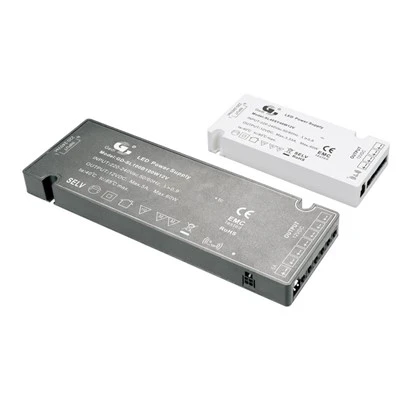
The most common shape you’ll see, and the one we ship for 70% of our orders, is rectangular. Wait, not just any rectangular—low-profile, compact rectangles, usually 4 to 8 inches long, 2 to 4 inches wide, and just 1 to 1.5 inches thick. Why rectangles? It’s a matter of efficiency in manufacturing and flexibility for installers. Most LED fixtures we work with, from linear high bays for warehouses to strip lights for storefronts, have linear mounting spaces. A rectangular driver slides right into the narrow gap between the LED strip and the fixture housing, no extra cutting or custom fitting needed. We’ve also found that the rectangular shape lets us distribute the sealing gaskets evenly along the edges, which reduces the risk of gaps. If you have a long LED run, you can daisy-chain two rectangular drivers if needed, something far harder to do with round models without creating dead gaps.
But rectangles aren’t one-size-fits-all. For outdoor signage—think large, backlit billboards or small business storefront signs—we often offer square waterproof drivers. A 4×4 inch square is perfect for the tight corners and back-of-panel mounting spaces that sign fabricators work with. Signage drivers also tend to handle higher power loads (up to 100 watts, vs. 60 max for most linear indoor-outdoor drivers) so the square shape gives us more internal space for heat sinks, which are critical for preventing overheating in drivers that run constantly for 12+ hours a day. We tested a round driver for a chain of fast-food signs a few years back, and the installers complained that it stuck out too far from the sign’s back panel, making it vulnerable to being knocked by maintenance crews. The square shape, which sits flush, fixed that problem overnight.
Now, let’s talk about the shape that confuses most people: round waterproof drivers. You’ll spot these on small, low-power applications: under-cabinet outdoor lights, landscape path lights, and small pendant lights for outdoor patios. Why round? First, their circular shape is inherently stronger against pressure—if a path light gets stepped on, or a driver is exposed to heavy rain that builds up pressure, the curve disperses force evenly, unlike a sharp rectangular corner which can crack under stress. Second, they’re far easier to seal. To make a round driver IP65 rated, you just clamp a rubber gasket around the edge of the circular housing and secure it with two bolts, no need to run gaskets along four straight edges, which can develop leaks if not aligned perfectly. For landscape installers, who often work on tight deadlines and have to mount dozens of lights in a day, the round drivers are a timesaver: they screw into a standard base plate without any trimming, and their compact 2×2 inch size fits almost every pre-drilled hole in landscape fixtures.
Wait a second, I know what some of you are thinking. What about odd shapes? Like, triangular, or custom-cut ones? For the first 8 years I was in this business, we’d get custom orders for odd shapes, but after 2016, we phased out almost all custom waterproof driver shapes. Why? The IP certification process for a custom shape costs 10 times more than a standard rectangular, square, or round model, and most installers don’t realize that custom shapes often have weaker sealing. A few years back, a retail client asked for triangular drivers for their triangular storefront awning lights, and within two months, 12 of 20 drivers had failed because the triangular corners were hard to seal evenly, so water seeped in during a rainstorm. We redesigned them as small square drivers, and none have failed since. The only odd shapes we still offer are low-profile, flat rectangular models for thin-profile fixtures—think ultra-slim outdoor wall lights that are less than an inch thick, where a standard 1.5-inch thick rectangular driver won’t fit. We call those “ultra-slim rectangles,” and they’re a big hit with architects who want a clean, modern look without bulky hardware.
Let’s get into the practical side, because shape isn’t just about manufacturing convenience—it’s about long-term performance. Last year, we did a follow-up study on 500 lighting installations we’d supplied drivers for, spanning three years. For linear high bays (where drivers sit inside the fixture housing, often in tight runs), rectangular drivers had a 3.2% failure rate, while round drivers for the same power load had an 8.7% failure rate. Why? Round drivers have a larger surface area to fit inside narrow linear fixtures, so they often have to be crammed into a space too small, leading to heat buildup that breaks down components faster. For landscape path lights, though, the numbers flipped: round drivers had a 2.1% failure rate, while rectangular had 5.8%. That’s because path light mounts are small, so rectangular drivers have to extend out further, making them more exposed to debris and pressure from foot traffic, while the round shape sits deeper in the base, protected.
I can’t tell you how many times I’ve heard installers say, “Just pick whatever shape fits.” That’s a mistake. A wrong shape doesn’t just make installation harder—it cuts the lifespan of your driver in half, which means more maintenance calls, more replacement costs, and more downtime for your lighting system. Let’s say you’re a facility manager for a grocery chain with 20 outdoor parking lot lights. If you pick a rectangular driver when a round one fits better, every three years you’ll have to replace 10 drivers, at $40 a pop, plus labor costs. If you pick the right shape, you’ll only replace one driver in three years. That adds up fast.
Another thing to consider: wiring. Most waterproof LED drivers have two sets of wires: one for input (connecting to the grid power) and one for output (connecting to the LED strip or array). The shape of the driver affects where those wires come out, which is a huge detail for installers who hate running extra conduit to route wires. Rectangular drivers almost always have wire exits on the two long sides, which lines up perfectly with linear LED strips that run along the length of a fixture. Round drivers, because of their circular housing, usually have wire exits on opposite sides, which works for small lights where the wires can be tucked into a narrow base. Odd shapes? They often have wire exits at awkward angles, leading to pinched wires, extra stress on the driver’s connection points, and more risk of water seeping in around the wires.
We’ve also started noticing a shift in what installers are asking for in the last two years. More and more architects are requesting low-profile rectangular drivers for modern outdoor lighting designs, where the goal is to have the entire fixture sit flush against a wall or ceiling, no bulk. We’ve responded by developing a series of 0.75-inch thick ultra-slim rectangular drivers, IP67 rated, that fit even in the thinnest fixtures. For hard-to-reach places—like the eaves of a warehouse, 30 feet up, where you don’t want to climb up to fix a bad driver—those slim rectangles are perfect because they’re lightweight and easy to hoist up, no bulky parts to weigh you down.
Let’s bust a common myth, too: some people think that round waterproof drivers are cheaper than rectangular ones, so they should just go with round to save money. That’s not true. The manufacturing process for round drivers requires specialized tooling, and the circular housing materials (usually UV-stabilized plastic, same as rectangles) cost the same. The price difference comes down to power load, not shape. A 10W round driver for a path light is about $12, same as a 10W rectangular driver, while a 50W square driver for signage is $35, same power load, same price. The only time shape affects price is for custom shapes, which we don’t recommend anyway.
Now, if you’re out there shopping for waterproof LED drivers, the first question to ask isn’t “What shape is it?” but “Where am I installing it?” Let’s break it down to make it easy:
- For linear lights (high bays, storefront strips, under-cabinet outdoor lights): Pick rectangular. They fit the linear mounting spaces, have even wire exits, and the lowest failure rate for your use case.
- For small landscape lights, path lights, and small patio pendants: Pick round. They’re easier to seal, sit flush in small bases, and are designed to withstand pressure and debris.
- For signage, billboards, and high-power outdoor fixtures: Pick square. They have more internal space for heat sinks, fit the back-panel mounting of signs, and handle the constant high load without overheating.
- For ultra-slim modern fixtures: Pick ultra-slim rectangular, which we designed specifically for this use.
If you’re not sure which shape fits your project, or you have a custom need that doesn’t fit these standard options, don’t guess. A wrong shape can end up costing you thousands in repairs and replacements over the lifespan of your lighting. We’ve been supplying waterproof LED drivers for over a decade, and we’ve worked with every type of installer, from one-man landscape crews to large retail chains, to get the right fit for every project.
I’ve seen too many installers cut corners by picking the wrong shape to save a few minutes on installation, only to spend hours fixing leaks, replacing fried drivers, and dealing with angry clients. It’s not worth it. The shape of the driver isn’t just a cosmetic detail—it’s a core part of its performance, durability, and ease of use.

If you’re gearing up for a lighting project, whether it’s a small residential patio or a large industrial warehouse, we can help you pick the right shape, power load, and IP rating to fit your needs. We’re here to answer questions, share data from past projects, and make sure you get a driver that lasts as long as your lighting system. There’s no such thing as a one-shape-fits-all waterproof LED driver, but there is a right shape for every job, and we’ll help you find it.
Low Voltage Cabinet Lights References
- International Electrotechnical Commission (IEC) 60529: Degrees of Protection Provided by Enclosures (IP Code), 2013.
- LED Lighting Society (LLS) Technical Report: Driver Design for Outdoor and Wet-Location Applications, 2021.
- Journal of Solid State Lighting: Performance Comparison of LED Driver Enclosure Shapes Under Environmental Stress, 2019.
- National Electrical Manufacturers Association (NEMA) Standard for Waterproof LED Drivers for Commercial and Industrial Applications, 2020.
Foshan Gedi Electrnoic Co., Ltd.
As one of the most professional waterproof LED drivers manufacturers in China, we’re featured by quality products and good price. Please rest assured to buy advanced waterproof LED drivers for sale here from our factory. If you have any enquiry about cooperation, please feel free to email us.
Address: 4th Floor, Building 8, South District, Huayi Decoration City, No.10, Laixiang Road, Shiwan Sub-district, Chancheng District, Foshan City, Guangdong Province, China.
E-mail: market@gedi-lighting.com
WebSite: https://www.gedi-lighting.com/
